
All 32 teams have submitted their final 23-man roster for the 2018 FIFA World Cup. Some shock inclusions and omissions have incited a lot of debates on who should or should not have made a respective squad. In Group G, with England, Belgium, Tunisia, and Panama, Gareth Southgate’s Three Lions and Roberto Martinez’s Red Devils are the clear favorites to advance, leaving Panama and Tunisia in the lurch. However, the Carthage Eagles of Tunisia could clinch a spot in the next round due to a unique factor.
In terms of squad personnel, Tunisia has 10 players that play in Europe and 13 that play elsewhere. A little less than 30 percent of their squad is comprised of players that play in the Tunisian league, which is the second most in their group (everyone on the England national team plays in the Premier League). Belgium and Panama, on the other hand, each have 13 percent of their World Cup squad playing in the Belgian and Panamanian leagues respectively. For Belgium, 20 out of 23 players play their club football in Europe, whereas in Panama only four out of the 23 play in Europe.
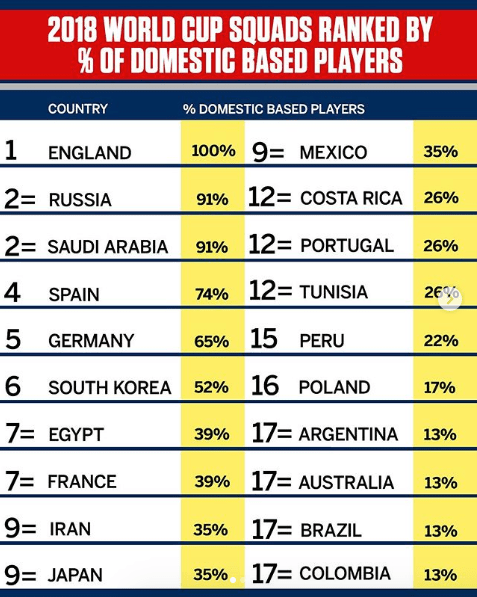
But what is unique about Tunisia is the balance. There is a good balance of players who play professionally in Europe and those who play elsewhere: Africa (Tunisia, Egypt) and in the Middle East (Saudi Arabia). Some European-based African players reluctantly join their national team when called, for the facilities, pay, and overall organization is subpar to that of their club. Some players decline a call-up altogether. In addition, there is an implicit superiority complex of players who play in Europe when reporting for international duty as they feel they are too good for the team. Players that play domestically tend to exhibit a greater devotion to the national team. You may ask, “How do you know players who play in Europe are troublesome?” Well, it’s an observation, I can’t prove it! But having European-based players in the squad adds experience and helps eliminate the fear some African nations have when they face big European teams. Some domestic-based players may have that fear. So having European experience as well as a commitment and devotion (and the grit and toughness of African football played in the domestic leagues) is a good balance that can challenge the other teams in Group G.
Tunisia is the only team in their group to have such an even balance, whereas the other teams are very lopsided. Could this balance positively affect their gameplay? Could it give them the courage to face formidable European sides in England/Belgium and provide the surprise element of “African football” to usurp them? We will have to wait and see. First game for Tunisia? England.
 Eddie Mungai
Leave a comment