
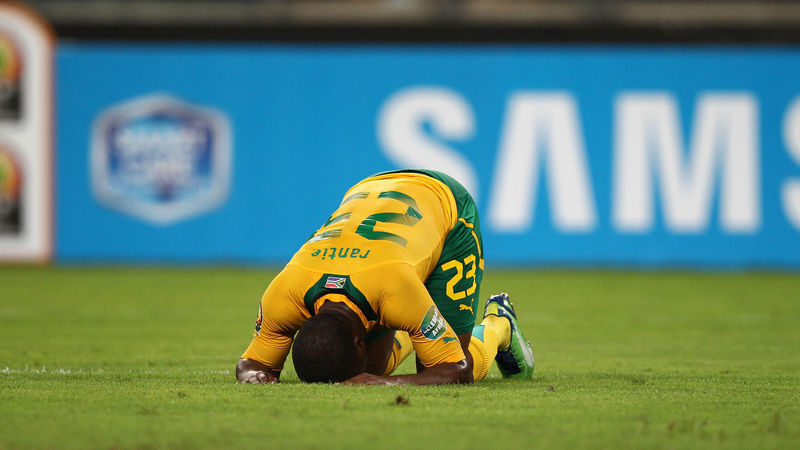
What can Bafana Bafana do to regain African fans’ support?
Legendary Portuguese manager Jose Mourinho once said,
“You are born loving a [team], you are going to die loving the same [team]. But sometimes you are not always in love with your team.”
African World Cup fans typically support other African teams. But the love is lost for one particular team. In the build-up to the opening match of the World Cup, where Mexico faces South Africa, many African fans are showing their support for Mexico and renouncing their support of Bafana Bafana:
The Nigerian fan’s fervent support for Mexico in the Instagram post mirrors the sentiments of a lot of African fans. I have a special spot for South Africa and its football teams, as I studied for a semester in Cape Town and Johannesburg, watched Orlando Pirates, and visited FNB Stadium, but my fandom has been tested.
Why would African fans actively choose not to support another African nation, such as South Africa?
It’s a protest—a public shunning of the ongoing xenophobic happenings across the country. There have been several violent incidents against African foreigners (in what’s more aptly called afrophobia) in the rainbow nation cities of Johannesburg, Pretoria, Durban, and Mossel Bay, unfortunately resulting in casualties. Some South Africans actually do not want their own nation to do well in this tournament because of the violence. And countries of the attacked victims are conducting repatriation plans.
Nigeria and Ghana have repatriated approximately 1000 residents. Mozambique followed with 400 residents. Malawi and Zambia retrieved 150 and 40 people, respectively. Zimbabwe is due to repatriate people and Namibia has said to those living in South Africa to effectively be careful. Those indifferent to these repatriation efforts may suggest there’s no material disruption to South Africa, as merely a thousand out of the millions of the aforementioned African residents are returning to their homeland. However, repatriations are not symbolic but rather are a calculated response to a recurring crisis, and xenophobia should be treated as such.
Xenophobic attacks against Africans, unfortunately, are not a novel issue in South Africa.
Xenophobia Attacks in South Africa
Xenophobia in South Africa stems from the belief that foreigners are taking the jobs of South Africans and committing more crimes. On the contrary, the former suggests foreigners boost GDP and the latter claims are unfounded. Major bouts of xenophobic violence occur roughly every five years since the mid 90’s, shortly after South Africa gained its independence. Even in 1995 during Nelson Mandela’s presidency, Mandela had to publicly condemn the attacks. Much of the violence happened in poor townships, such as in 2008 in Alexandria (a township near Johannesburg), in 2015 in KwaMashu (a township near Durban), and in 2019 in areas like Johannesburg and Pretoria. What makes this year’s violence different than the previous years is the involvement of politicians—they contribute to the inflammatory discourse around foreigners, scapegoating them for creating tough conditions in South Africa. That’s a first, and it’s worrisome.
This is a stark contrast from what was on display for the world in 2010, when South Africa, the hosts of the World Cup, was the venue that championed pan-Africanism, tooting their vuvuzelas in support of Ghana in the knockout stages on their way to the quarterfinals. It was the place where Siphiwe Tshabalala’s opening goal of the tournament was the “goal for all of Africa.” Sixteen years on, the nation is ostracized by African football fans for its xenophobic violence. It makes one think South Africa’s hosting was just for show, from a football and ideological standpoint.
History of Football and Politics in South Africa
Soccer in South Africa has more often than not been politically tied. Between 1964 and 1992, the South African football governing body at the time was suspended by FIFA because of South Africa’s apartheid policies and its refusal to field a non-white player on the men’s national team. In Chuck Korr and Marvin Close’s book More Than Just a Game, they talk about how male prisoners detained on Robben Island would organize leagues and play football to express themselves, proving to the prison regime and to themselves that they could be disciplined and work together cooperatively. Football was also used by the prisoners as a stepping stone for bargaining. After earning their right to play football in prison, it gave them the self-determination to negotiate better food. Football was a tool to combat apartheid and garner self-pride. Anti-apartheid efforts once galvanized African countries in support of South Africa. Now Africans are uniting to shame Bafana Bafana because of South Africa’s afrophobia.
The South African football team has the opportunity to replicate the bravery and brashness of their bold forefathers and use football to combat afrophobia and promote unity. But you won’t likely see a statement from the South Africa Football Association (SAFA) or a member of Bafana Bafana condemning the remarks of politicians inciting the violence against African foreigners in South Africa.
If they do speak, however, their voice will not be the loudest.
The anti-xenophobia discourse is loud, and it’s led by vocal Africans online.
Rooting for Bafana Bafana in the World Cup
People can separate the politics from the team, much like how one can separate the person from the artist. Politics and football (and sports, in general) coexist, and it’s difficult for me to separate the two.
But I’m not in love with Bafana Bafana, and so many other fans, because of their mishandling of afrophobia attacks in South Africa.
South Africa is in Group A, along with Mexico, Czechia, and South Korea. Out of tough love, I hope for the following results:
Mexico (3) – South Africa (0)
Czechia (3) – South Africa (0)
South Korea (3) – South Africa (0)
A straight drubbing in all three group games, resulting in an elimination from the group stage.
Focus on quelling the afrophobia.
Follow me on Bluesky!
 SuperBafanaStars
Leave a comment