
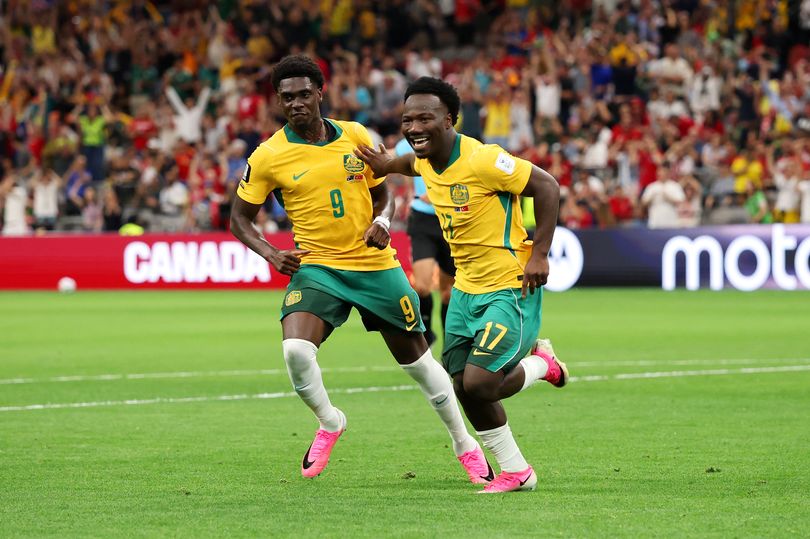
The Australia men’s national team began their World Cup facing Group D contenders Türkiye in Vancouver. It was a late kickoff, with the match starting at 9pm Pacific time (midnight Eastern time for folks on the East Coast), but Australia was not deterred by the moment or Türkiye’s quality of players. Hakan Çalhanoğlu, Kenan Yıldız, Arda Güler, and the team were stifled by Australia’s impenetrable defense. Spectacular goals by Nestory Irankunda and Connor Metcalfe settled the game. Australia’s 22-year-old goalkeeper played a significant role in quelling the Turkish team while facing 28 shots. It was a marvelous victory before their impending encounter with Group D leaders USA.
But that was their second victory of the World Cup.
Their first victory? Their posted video statement addressing their support for diversity and multiculturalism and reprimanding anti-immigration discourse.
Days before their first game of the World Cup, Socceroos national team veteran Jackson Irvine, who also serves as co-president of the Professional Footballers Australia (PFA) players’ union, led several meetings to discuss what kind of statement the Socceroos would like to make before the tournament. It’s not news that the World Cup joint hosts, the United States and its administration, have recently implemented anti-immigration policies related to ICE raids and travel bans, and also contributed to inflammatory speech. Australia also has anti-immigration rhetoric, with the rise of former fish and chip shop owner turned senator Pauline Hanson and the One Nation political party.
In the nearly two-minute video, 20 of the 26 players shared their birthplaces and connections to Australia. There were messages from players, like Awer Mabil for instance, that shared his birthplace was in Kakura refugee camp in Kenya to South Sudanese parents, and acknowledged the varying journeys behind the jersey but ultimately having a lot of pride being a Socceroos and representing the country proudly. Messages from “allies” or teammates that trace their ancestry and heritage to Australia shared the importance of recognizing differences and that “no matter where you come from, football is for everyone”.
The Socceroos have a lot of players with multicultural identities, including goalscorer Nestory Irankunda. Here’s a summary of the other players on the squad and their countries of affiliation, including their birthplaces or heritage.
| Player Name | Affiliated Country |
| Nestory Irankunda | Tanzania, Burundi |
| Awer Mabil | South Sudan, Kenya |
| Mohamed Touré | Guinea, Liberia |
| Lucas Herrington | Zimbabwe |
| Jason Geria | Uganda |
| Tete Yengi | South Sudan |
| Alessandro Circati | Italy |
| Cristian Volpato | Italy |
| Miloš Degenek | Serbia |
| Harry Souttar | Scotland |
| Cameron Burgess | Scotland |
| Ajdin Hrustić | Bosnia & Herzegovina, Romania |
| Nishan Velupillay | Sri Lanka |
| Aziz Behich | Cyprus |
This isn’t the first time they made a statement before the start of a World Cup. Prior to the 2022 World Cup, 16 members of the Australia men’s national team made a video condemning host nation Qatar’s human rights violations related to migrant workers and its anti-LGBTQIA+ stance. The players were pointed in their criticism, also demanding some reforms to improve the conditions of migrant workers, such as the implementation of a migrant resource center. They also wanted a “decriminalization of all same-sex relationships.” Australia’s message before the 2026 World Cup, however, is not as targeted, given the climate cultivated by the current administration in the USA and the methods in which they punish people, groups, and organizations in direct opposition to their agenda. Thus, the subtext of their multicultural message had to do the bulk of the talking. The message, nonetheless, is significant given that no other team has issued a unified critique of the anti-immigration sentiment in the US. Their message is also directed to the Australian community.
Did they have to make a statement? Absolutely not. But even when it wasn’t required, even when it is not common for soccer players and teams to issue a collective statement, and given the potential to generate friction (within the team and outside of it, made visible by the Australian media), they did it anyway and found it necessary, considering the diverse makeup of their team.
That’s why it is a win in my book.
Other nations could have shared a similar statement to the Australian national team. Iran’s decision to negotiate with FIFA to move its group stage matches out of America was a subtle statement, but that was a necessity due to genuine concerns of a lack of safety assurances from the United States during the ongoing war with the USA. Australia’s statement was significant, as it was optional and in support of their players from multinational backgrounds.
The next World Cup will be jointly held by Spain, Portugal, and Morocco. If Australia qualifies, I’m sure the public will be half expecting a statement from the national team. What message would they issue? I will say that none of the three countries is absolved of criticism.
Follow me on Bluesky!
 SuperBafanaStars
Leave a comment