
In the 2006 World Cup, Ghana made their tournament debut and played like they had nothing to lose. In their group were the United States, the Czech Republic, and Italy, and they finished second after defeating both the United States and the second-highest-ranked team in the world in the Czech Republic. They advanced to the knockout stage and lost to Brazil. In the 2010 World Cup, Ghana improved on their 2006 success and advanced to the quarterfinals after defeating Serbia, drawing Australia, and losing to Germany in the group stage. After winning against the United States in the Round of 16 and advancing to the quarterfinals against Uruguay, Ghana was inches away from advancing to the semifinals (we all know what happened there).
Those Ghana teams had real quality. Those Ghana teams were fearless. They even had Team USA calling the Black Stars rivals. The Ghana I saw play the other night was a shell of itself, far from the dominant team of the last 20 years. And I saw some things that made me certain they wont advance to the knockout stage this World Cup.
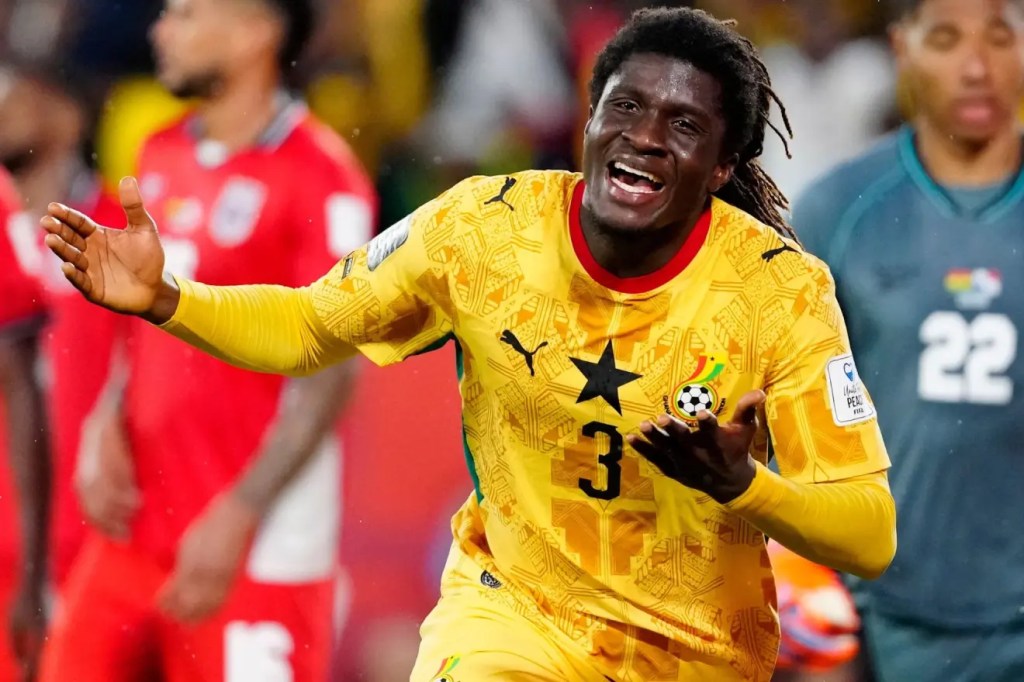
Wednesday’s match against Panama was not one of the memorable matches of the tournament thus far. It finished 1-0 to the Black Stars, but they sure made it hard for themselves. Sloppy passes galore. Inconsistent possession. Inadequate service to the attackers.
To put it lightly, it was an eyesore for much of the game, especially compared to what I’ve been accustomed to seeing from the Black Stars.
And there’s a culpable party in Ghana’s disjointed play.
I don’t blame the players. I don’t blame the manager.
I blame Ghana Football Association president Kurt Okraku.
And I saw signs leading up to this match and during the game against Panama that told me everything I needed to know.
Kurt Okraku’s Impact
Kurt Okraku has been president of GFA for the last seven years. Since being elected as GFA president in October 2019 following his predecessor’s corruption-riddled tenure, Okraku improved the GFA technical center, increased financial support to domestic leagues and their clubs, and launched youth football for girls at the U-15 level. Okraku recognized the unique opportunity of serving as the leader of GFA when he took office, aiming to “look into the future with hope and build a solid foundation.”
However, Okraku has fired 6 managers in six and a half years. The short shelf life of Ghana football managers is a curious one, and raises questions to the “solid foundation” he sought to build.
Former Black Star player Otto Addo was the latest manager to be fired by Okraku back in March after a 2-1 loss to Germany in a friendly, their fifth straight defeat. His dismissal caught former GFA Chairman of the U-15 Management Committee Ralph Gyambrah’s attention, and he wondered if GFA’s foundations are sound. “When decisions are being taken to hire a coach for the Black Stars, the decision must be thought through so that you minimize chances of failure—but we did not do it that way,” Gyambrah said in an interview with a local radio station.
Addo had the highest win percentage out of any manager hired by Okraku, and they even went undefeated in competitive matches in 2025. But the former journalist-turned football federation president wanted to make another change, bringing in Portuguese manager Carlos Queiroz.
He appears to be a demanding figure Mr. Okraku—one who expects a certain standard (his) to be met and when it’s not, it’s followed by curt action. And his facial expressions during the Panama game couldn’t hide what he was feeling.
Unnecessary pressure from Okraku
Tuning into the game, I saw the camera pan over to the Team Ghana delegation of distinguished guests, specifically Ghana Football Association President Okraku and Ghana Football Association Vice President H.E. Professor Jane Naana Opoku-Agyemang. Okraku has a focused look, a countenance reflecting the message, “Let’s get down to business.” In fairness, the camera panned to them during the middle of the national anthem so he was probably focused on that.
But when Ghana midfielder Caleb Yirenki scored the late winning goal in added time, the camera, again, panned to the Ghana delegation after the winner, and the GFA president and vice president couldn’t have had more contrasting emotions.
It’s as if the way in which they won was not good enough for Okraku, which I agree.
This is a man that delivered a team talk after Ghana failed to win an African Cup of Nations qualifier against Niger. He charged the team to beat the Sudan team in the next qualifying games and they failed to do so on two occasions.
And in the lead-up to this World Cup, Okraku said Ghana “will crush” all of their opponents in the group stage. The Panama victory wasn’t exactly a dominant victory, and there’s no guarantee of a win or dominant performance against England or Croatia.
He adds unnecessary pressure.
So it’s possible in that moment where the video was taken after the game winner, he was probably not satisfied and was thinking about expressing his displeasure on how they played even though they won. He’ll probably implore the team to play their absolute best against England and Croatia.
But they won’t win, unfortunately, because of Okraku’s demands and pressure.
And speaking of pressure, Carlos Queiroz celebrating with the fans after the match as if they beat a global soccer powerhouse told me that coach is already feeling the pressure after only his third game in charge.
This Ghana team is not like what it once was, and I don’t blame the players nor the coach. The GFA President destabilized the team three months before the World Cup by firing Otto Addo. His ruthlessness and astronomical standards add unnecessary pressure and it is detrimental to the team.
This team won’t make it to the knockout stage under Okraku. For the good of Ghana football, he must go.
Follow me on Bluesky!


Leave a Reply