
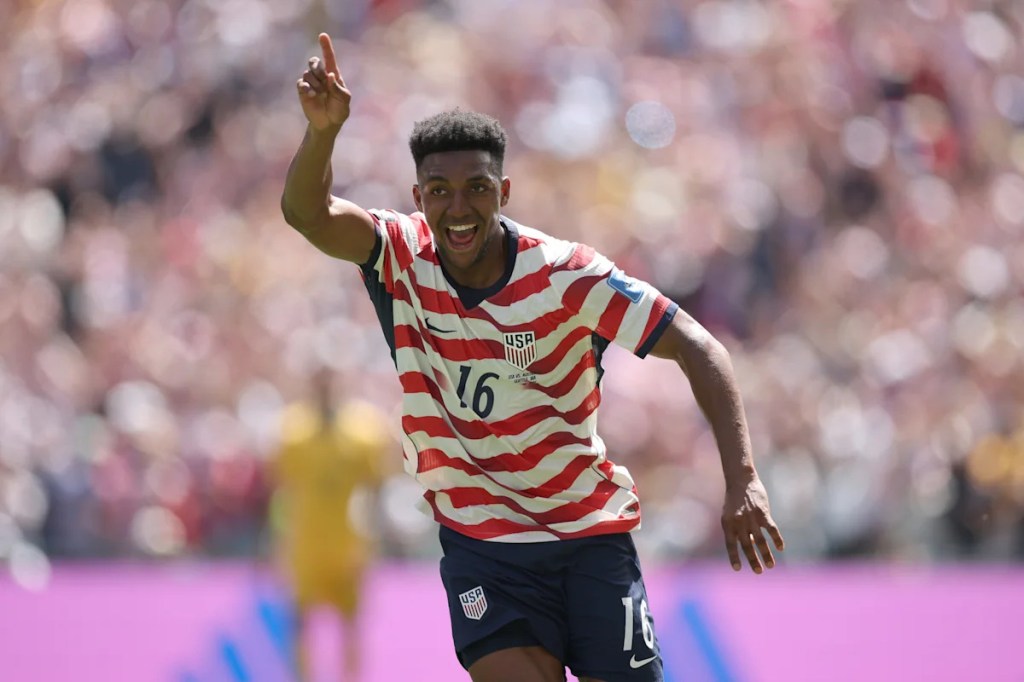
The first black player to represent the United States men’s national team was Haitian-born Joe Gaetjens, known for his game-winning goal against England in the 1950 World Cup. The first US-born black player to represent the United States was Eddie Hawkins in 1984, with his first and only appearance for the Red, White, and Blue. The first US-born black player to represent Team USA during the World Cup was Desmond Armstrong in the 1990 edition of the tournament.
In the spirit of Juneteenth, acknowledging the trailblazing black players for the US men’s national team only seems right. It shows how far the team has progressed in terms of featuring black players on the roster.
This summer’s World Cup has been an enjoyable one, especially for the host nations. Mexico played their first World Cup game in Guadalajara yesterday in a 1-0 win over South Korea, where El Tri became the first team to confirm their spot in the Round of 32. Canada conducted a 6-0 demolition over Qatar, with legendary Canadian women’s soccer player Christine Sinclair in attendance, as the men’s team secured its first-ever World Cup win. And the United States secured its place in the knockout stages after defeating a tall, strong Australia team 2-0.
And it’s so fitting it happened on Juneteenth.
Juneteenth for those not in the know
In 1865 during the latter stages of the Civil War between the Confederacy and the Union, Union soldiers went to Galveston, Texas to announce the end of the war and subsequently say that all enslaved people were free (note: slavery officially ended with the 13th amendment in December 6, 1865). Although the Emancipation Proclamation ordered the freeing of enslaved people in confederate states on January 1, 1863, the news did not reach Texas until June 19, 1865. It became a federal holiday in the United States five years ago and is seen as a day to celebrate black people and culture as well as black history.
Given this holiday, it was a good moment for the US Men’s National Team to win. And a number of black players were key contributors during this game:
Key contributors against Australia
Folarin Balogun
There was a feeling the US was going to use Balogun’s speed to stretch the compact Australia back line. And indeed they did. Balogun was critical for the opening goal, bursting down the left wing and charging into the box. His subsequent cross forced an error by the Australia defender, who inadvertently kicked the ball into his own net. Balogun had another chance in the second half, a one-on-one against the goalkeeper, but the Australian defender got back in time to deflect his shot. He had minimal touches during the entirety of the game, but he made the most of them.
Alex Freeman
Freeman influenced both sides of the game in this match. Defensively, he was solid, especially in the second half where he was contesting aerial duels with the large center backs of Australia. He did have a fantastic block on Australian winger Nishan Velupillay, and if it wasn’t for his intervention it would’ve likely been a goal. As a member of the right side of a back three, he found himself in advanced positions, coordinating well with Weston McKennie and Serginho Dest on the right wing. Freeman’s defining moment, of course, was his reaction to the deflated shot, allowing him to jump and head the loose ball for the second goal.
Chris Richards
Serving as the middle center back of a back three, Richards took care of the ball in the back when goalkeeper Matt Freese misplaced a couple of passes in the first half. Richards was also crucial in the second half as Australia was attacking and playing balls in the box. He won a lot of aerial duels and had a number of key blocks on speedy winger of Burkinabe descent Nestory Irankunda and Harry Souttar.
Antonee Robinson
Similar to how Balogun was an outlet to stretch the Australia defense, Robinson was also utilized in the same manner. He commanded the left side in the first half when the US was most dangerous, sending in crosses for the two center forwards.
Tyler Adams
As you would expect, he was the combative cog in the midfield. He also dropped deep in the box when Australia was launching balls in the box in the second half. The former captain of the US men’s national team, he led the midfield.
Weston McKennie
The man of the match, in my opinion. He featured mainly on the right side of the pitch in attack, functioning as a right midfielder. With a team void of Christian Pulisic due to injury, he was one of the key creative options for the US. Also, as a bonus, he had his hair dyed in Juneteenth colors. That was pretty special.
Malik Tillman
He was fluid and smooth on the ball. He had some great one-twos with Antonee Robinson in the first half. Additionally, he was everywhere. He occupied the left flank, the right, and he was also in right back as well.
Serginho Dest
As mentioned earlier, he had a great connection with Weston McKennie on the right, and the team exploited the right side for most of the game. Dest also counter-pressed the Australia defense, forcing them to make a number of errors with their passes. As a result, Dest was able to help regain possession and immediately resume his dominance on the right.
Auston Trusty and Haji Wright made appearances as well.
That’s 10 black players fielded in a match for the US men’s national team. I cannot remember the last time the national team played this many black players. Thanks to the black players before this generation for making this possible.
What a wonderful Juneteenth!


Leave a Reply