
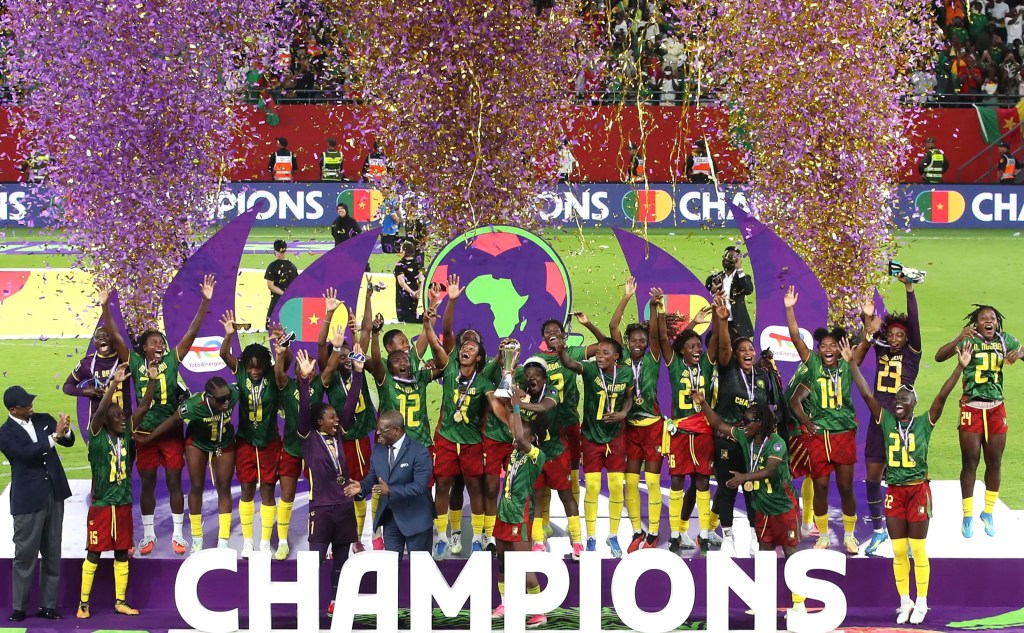
This was a fun Women’s Africa Cup of Nations. I didn’t get a chance to watch the tournament as much as I would’ve liked compared to how I watched AFCON or this summer’s World Cup. I blame the broadcast for the slight inconvenience. Being based in America, I could stream it on Bein Sports Connect, but I had to download the app on my phone and AirPlay the match to the TV (the AirPlay wouldn’t always work on the first try so I had to disconnect and reconnect to the TV several times, taking me approximately 5-7 minutes to set up the watching experience—there are bigger concerns in this world than this so I’m not mad). But even with those challenges, it was a tournament worth remembering. Cameroon won their first title, and it was the first time that all semifinalists had never won WAFCON. It was the largest tournament with 16 participating teams.
Similar to past WAFCON tournaments, this one was postponed 12 days before its original April start date. Additionally, there were some dodgy commentary personnel—some sounded like they didn’t want to be there and others sounded like newbies to football. But either way, it was a tournament with a number of upsets, as reigning champions Nigeria were knocked out in the quarterfinals.
Other memorable moments stick out to me. Cabo Verde scoring their first-ever goal in WAFCON, Lina Boussaha channeling her inner Louisa Necib in her skillful play across several games throughout the tournament, the Chemwa sisters carrying Malawi, or my personal favorite, Michaely Bihina’s goalkeeping heroics. This tournament had it all on the pitch.
What ensues will be far greater. With Malawi and Cabo Verde making their WAFCON debuts, one can imagine what impact their presence can have on people in their nation. This is what was said during last year’s WAFCON, and it rings true in 2026:
“When South Africa’s Banyana Banyana broke Nigeria’s long-standing dominance to win their first WAFCON title in 2022, they also proved that visibility goes beyond mere participation. They became a symbol of progress, pride, and possibility for countless girls across the global majority. That ambition isn’t limited by gender, geography, or tradition. That the pitch can be a place of real, transformative power.” (Source: Dazed MENA)
For instance, following Malawi’s thrilling WAFCON campaign, the team could earn north of $10 million for making the WAFCON final and qualifying for the 2027 World Cup, a significant amount of money that is more than their annual budget. If used correctly, these funds can improve grassroots football, build training grounds, renovate existing stadia, and support the national team as they prepare for their first women’s World Cup in Brazil next year. As often stated, African football and the mismanagement of dollars by football federations is an all-too-common issue that must be addressed. This is a critical period for the Football Association of Malawi, as how they use the funds can shape football development for decades to come.
For me, the bulk of the money has to go to grassroots football first. It’s imperative.
And the presence of WAFCON participants will, without question, bring notoriety that helps African players make moves to bigger clubs. For instance, Côte d’Ivoire’s N’Sira Ouedraogo is bound to make a big move somewhere; she was electric in the tournament. And when these African players make a move to a bigger team, they must be taken care of. In an article featured in The Athletic by Tamerra Griffin, it states that even though African talent is in abundance, for those who are trying to play elsewhere outside of Africa, there aren’t systems that are equipped to make that move. Take the English FA for example:
“The federation admits international players to its leagues based on a government endorsement body (GBE) point system that takes into account the FIFA world ranking of the player’s national team, and the number of minutes a player has registered with their national team and in other top club competitions. This scoring rubric is skewed, often devaluing African and Asian competitions while elevating European, North American and South American ones. Nigeria (36th) is the only African national team in the top 40 of FIFA’s world ranking.” (Source: The Athletic)
That stinks, to put it frankly. The NWSL also struggles to retain African players, with many arriving from Europe and elsewhere but then being loaned or sold back to Europe after a couple of years. The NWSL club with the highest African representation is the Washington Spirit (with six participating in WAFCON). So the Spirit seems to have a model that’s working for African players.
This was a tournament that not only had the entertainment value on the pitch, but produced some key insights off of it. Two action items stand out for the federations of the WAFCON participants and world football:
- To football federations whose women’s team featured in WAFCON: put the money you earned into grassroots football
- To world football leagues wanting to add African women footballers to their teams: ensure there’s a stable environment for them to grow and succeed


Leave a Reply